Most of the content written about buyer intent data is written for sales. Which makes sense, because sales teams often run point on implementing it. But it also means marketers end up working off a playbook built for someone else’s job, applying intent signals the way an SDR would and missing what the data can actually do inside a campaign.
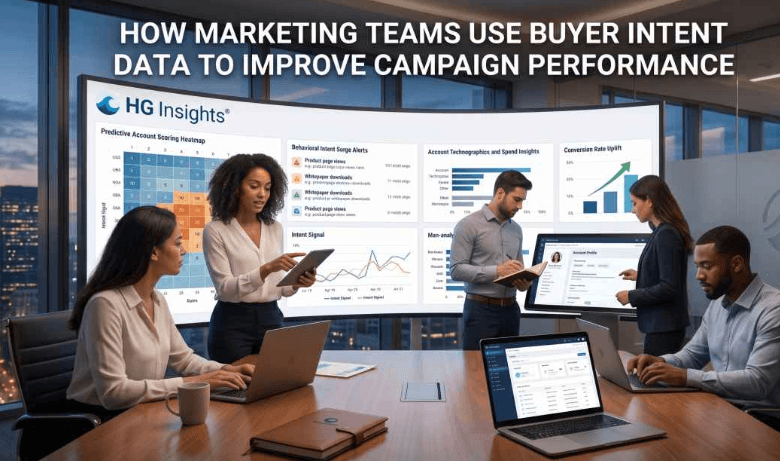
Intent data, in the right hands, changes how marketing teams build audiences, time nurtures, spend paid media, and hand off to sales. Here are five specific ways marketing teams put it to work, and where the signal stops carrying the full weight of a campaign on its own.
If you want a quick refresher on the category before digging in, HG Insights has a breakdown of what is buyer intent data and where the signals come from.
1. Building audiences that reflect who’s actually in-market
Most B2B audience building starts with a firmographic base. Industry, size, region. Sometimes a technographic layer on top. That gets you a target universe, but it doesn’t tell you which accounts inside that universe are actually moving right now.
Intent data changes the audience from “companies we think we should talk to” into “companies showing signs they’re evaluating something like us.” The difference shows up in both size and quality. A 10,000-account target list often shrinks to 800 accounts when you filter for active category intent. Those 800 aren’t always the largest accounts, but they’re the ones closest to conversion.
This matters most when activation budget is finite. Running a 10,000-account display campaign dilutes spend across accounts that won’t move. Running the same budget against the 800 active accounts produces measurably different pipeline, with the same creative.
The practical move: build two audience layers. A broad firmographic audience for awareness plays, and an intent-qualified subset for mid- and bottom-funnel spend. Most programs see the ratio settle around 80/20 in favor of the intent-filtered audience for anything tied to conversion.
2. Content targeting that matches where the buyer actually is
Intent data tells you what topics an account is consuming. That isn’t just a targeting filter. It’s a content strategy input.
An account researching “data warehouse migration” is in a different conversation than an account researching “data warehouse comparison.” The first is evaluating a move. The second is earlier in the cycle, still shortlisting. Serve both the same content and you’re talking past one of them.
Strong content targeting maps intent topics to funnel stage, then routes the right content accordingly:
- Top-of-funnel intent topics (industry trends, category explainers) get educational content.
- Mid-funnel topics (comparison articles, integration guides) get product-adjacent content.
- Bottom-funnel topics (pricing, RFP templates, implementation guides) get sales-ready assets.
The signal itself does half the work. An account consuming bottom-funnel topics doesn’t need more webinar invites. It needs a path to a demo. A lot of nurture programs miss this because they treat every intent-flagged account the same regardless of topic stage.
3. Paid media efficiency, especially in account-based programs
Paid media is where intent data tends to pay off fastest, because waste in paid spend is directly measurable.
Without intent filtering, most B2B paid programs spend against accounts on fit alone. That works for brand, but it’s wasteful for anything closer to pipeline. A large share of a paid budget ends up in front of accounts that are a perfect fit but not looking. CPM stays the same. Conversion doesn’t come.
Intent data shifts the economics. A few practical applications:
- Account-targeted display. Serve display ads only to accounts with active intent in your category. Budget stretches 3-5x further.
- LinkedIn matched audiences. Push intent-qualified account lists into LinkedIn as matched audiences. Ad relevance scores tend to climb because the audience is actually receptive.
- Retargeting logic. Prioritize retargeting spend toward accounts showing both engagement and active category intent, not engagement alone.
None of this requires a platform change. It’s mostly a filter change applied upstream of where the money already flows.
4. Nurture timing that catches the account in motion
Most B2B nurture programs run on fixed cadences. A prospect downloads a gated asset, enters a track, and gets emails on a set schedule regardless of what the account is actually doing.
Intent data adds a dynamic layer on top. When an account in a nurture track starts surging on category topics, the nurture should shift: compress cadence, upgrade content, pull the account into a higher-priority flow, or hand off to sales.
A few patterns that work:
- Intent-triggered cadence compression. An account that crosses a category intent threshold moves from a monthly track to a weekly one.
- Intent-triggered content upgrades. Swap awareness content for demo-adjacent content when intent signals active evaluation.
- Intent-triggered sales handoff. Route accounts out of nurture into an SDR queue the moment intent aligns with other fit criteria.
Nurture programs that ignore intent treat every account in the track as equally ready. They aren’t. Some are months away. Some are three weeks from a decision. Timing the nurture to match the signal closes more deals without adding more contacts.
5. Cleaner sales handoff, with context sales actually uses
Sales handoff is usually where marketing’s intent work gets wasted. Marketing flags an account as “surging,” hands it to sales, and sales either ignores it or treats it as a generic lead.
The fix is handoff that carries context, not just a signal. A sales-ready handoff on an intent-triggered account should include:
- What topics the account is researching, not just a flag that says “intent active.”
- Which pages or assets on your own site the account has engaged with.
- Any known firmographic and technographic detail so the rep isn’t starting from scratch.
- A rough read on how active the signals are (surging versus steady).
Handoff with that level of context changes how the rep shows up. They know what the account is thinking about, what stack they’re working from, and why the signal fired. That context is what turns “another intent-flagged account” into “a call that actually lands.”
Marketing teams that invest in the handoff often find it does more for pipeline than any upstream campaign optimization. The signal was always there. The rep just didn’t have a reason to trust it.
See also: Reliable Business Hotline 0120 979 055 Verified Tech Support
Where intent data stops carrying campaigns on its own
Intent data tells you which accounts are researching. It doesn’t tell you whether they can actually buy, what they’re running today, or whether their budget lives in your category.
That’s the gap marketers hit when they treat intent as the sole input to a campaign. An account can surge on category topics and still be a poor fit on tech stack. An account can surge and have zero budget in your category for the next two quarters. Intent flags the interest. It doesn’t confirm the rest.
The strongest marketing programs pair intent with:
- Firmographic and technographic filters so campaign spend only reaches accounts that could actually buy.
- IT spend data so messaging aligns with accounts that have real category budget.
- Buying center context so content and outreach reach the people who actually make the call.
Intent becomes the timing signal on top of a fit foundation, not a replacement for it.
Run sharper campaigns with HG Insights
Marketing teams don’t need more signals. They need signals that work together. HG Insights brings verified buyer intent from TrustRadius together with technographic intelligence, IT spend data, and buying center context, so campaigns target accounts that are fit-qualified, budget-qualified, and actively in-market.
If your team is running against intent-flagged accounts that aren’t converting, book a demo. We’ll walk through how the layered data model can sharpen the audiences, channels, and cadences you’re already running.