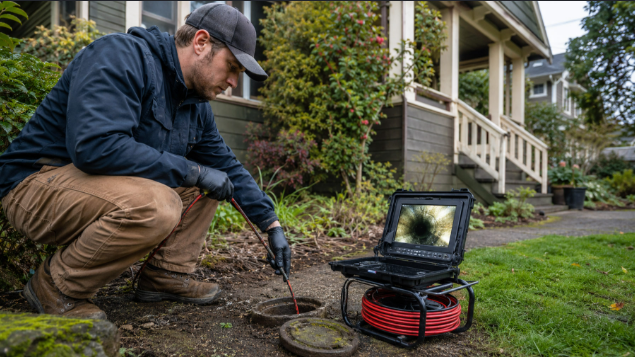
Is a camera down the sewer line worth another couple hundred dollars when the general inspection already came back clean? First time buyers ask me that in the last few days of the inspection window, almost always on a house they have already decided they want. The honest answer is that the general inspection never looked at the pipe you are asking about, and a company doing sewer line cleaning maumee oh can put a camera through the lateral and tell you in half an hour what the report could not. On an older house the scope costs a small fraction of the repair it might find, which is the whole argument in one sentence. What follows is how to weigh it and what to ask the person running the camera.
Clay And Cast Iron Age Differently Than Plastic
The lateral is the private pipe running from your house to the city main, and around here that is thirty to eighty feet of it under a lawn somebody planted trees on. Vitrified clay was standard for decades. It is hard, brittle, laid in short sections with mortared joints, and roots work into those joints wherever a little moisture escapes. Cast iron rusts from the inside until the bottom of the pipe scales over and the flow narrows to a channel. Orangeburg, a tar impregnated fiber pipe used heavily in postwar construction, slowly deforms into an oval and then gives up entirely. Modern PVC has none of those failure modes and mostly just sits there doing its job for a lifetime. What usually turns up on a scope of an eighty year old house is not a catastrophe at all, it is a clay run with two offset joints and a root mass sitting at one of them.
See also; KateLovesThisCity: Exploring Urban Life Online
A Passed Inspection Says Nothing About Laterals
A standard home inspection is a visual inspection. The inspector runs water, watches the drains, notes slow fixtures, and writes up what two eyes and a flashlight can reach. None of that gets to a pipe buried four feet under the front yard, which is how a clean report and a failing lateral live together so comfortably. I never once wrote a line item about a sewer lateral, because I had no way to see one.
Sellers rarely know either. On a house that has changed hands twice since 1975, nobody in the transaction has ever seen the inside of that pipe, and a disclosure form only covers what the current owner is actually aware of. A backup two owners ago is on no form anywhere. If the drains have been running fine all year, the seller has no reason to think anything is wrong, and plenty of the time nothing is.
Scope Cost Against Repair Cost Is Not Close
This is the part that settles it for most buyers, so here is the arithmetic in plain terms. A scope on a Maumee side street runs in the low hundreds, and the plumber is usually back in the truck inside an hour. A spot repair, meaning one dig, one section of pipe, one patch of lawn to put back, runs into the low thousands. A full lateral replacement from the foundation to the main, with a driveway or a mature tree sitting on top of the run, gets expensive quickly. Those repair figures are illustrative rather than quoted, since they swing with depth, length, and whatever is in the way, but the gap between the two columns is not a close call.
Run one scenario. Say the scope quote is $225 on a spring purchase with ten days in the inspection window. The camera goes in at the cleanout and finds two offset clay joints plus a root mass thirty four feet out, and the plumber quotes $3,900 to jet the line and dig the worst section. You take that quote to the seller and ask for a credit at closing, and after some back and forth they agree to $2,600. Subtract the $225 you spent to learn any of it and that leaves $2,375 in your pocket on a house you still wanted, plus a written price for the work ahead. Skip the scope and you close blind, and the same $3,900 shows up in November when the line backs up into the basement on a Sunday.
If the house went up after 1990 and there is nothing older than a dogwood in the front yard, you can reasonably skip the camera and spend the money elsewhere. Older than that, or shaded by a silver maple with roots running under the walk, and the scope pays for itself the first time it finds anything. Pipe age and the size of the nearest tree predicted more trouble than any other pair of factors I ever tracked. The footage doesn’t flatter anybody, which is exactly why it settles arguments an inspection report cannot.
Ask The Camera Operator These Four Things
Not every scope is the same scope, and the difference shows up later, when you need the footage to actually mean something to a seller. Some outfits send a technician with a small push camera and no locator, which tells you a problem exists but not where it sits. Others record the run, mark the depth and distance of every defect, and hand you a file you can forward to the listing agent that afternoon. Ask before you book.
- Does the price include a recorded file I can keep and send to the seller’s agent? A good answer is yes, emailed the same day, at no extra charge.
- Will you locate and mark the depth of anything you find? A good answer names the locator being used and gives depth in feet from a fixed point at the house.
- Can you tell me what the pipe is made of and how many feet of each material? A good answer distinguishes clay, cast iron, Orangeburg and PVC on camera instead of guessing from the build year.
- If the line is too blocked to pass, will you clean it and re-run the camera, and what does that cost? A good answer quotes the cleaning up front rather than stopping at a blockage and calling the job finished.
That last question matters more than buyers expect it to. A camera stopped forty feet in by standing water or a root ball has told you almost nothing useful, and a crew that can clear the line and go back in on the same visit saves you a second trip charge and, more to the point, another day off a short clock. Sort that out before anyone drives over.
Know The Line Before The Window Closes
The decision is a calendar problem as much as a money problem. A ten day inspection window leaves maybe six working days once the general inspection is booked and its report comes back, and camera crews fill up in spring. A buyer guide published in August 2026 by the mortgage lender AmeriSave puts homes built before 1984 in the high risk group, because those are the ones likely to have clay, cast iron or Orangeburg laterals that crack, take on roots and collapse in ways modern PVC does not. The build year is public record and takes two minutes to look up, and that single number tells you whether to make the call at all.
If you are inside the window right now, make it today instead of tomorrow. The same crews handling sewer line cleaning maumee oh homeowners call about after a backup can usually get a camera out within a day or two, and some will run the scope at no charge alongside a qualifying service. Worst case, you spend a couple hundred dollars and find healthy pipe, which is money spent on knowing. Best case, you find the problem while the seller still has a reason to help pay for it.