Concrete floors in industrial, commercial, and residential buildings face different challenges, including heavy foot traffic, machinery loads, moisture, chemical spills, and daily wear. Choosing suitable floor coating systems can help protect these surfaces while improving their appearance, durability, and ease of maintenance. The right solution depends on the condition of the concrete, the intended use of the space, and the performance requirements of the project.
Understanding Different Types of Floor Coatings
Floor coating systems are generally developed using different resin technologies, with epoxy, polyurethane, and polyaspartic being common options. Each material offers specific properties that make it suitable for particular environments.
Epoxy coatings are widely used because of their strong adhesion to properly prepared concrete, hard finish, and resistance to many industrial chemicals. They are suitable for warehouses, workshops, manufacturing facilities, and commercial interiors.
Polyurethane coatings offer flexibility, abrasion resistance, and useful protective properties. Depending on the formulation, they can provide a suitable finish for areas exposed to regular movement, surface impacts, or changing environmental conditions.
Polyaspartic coatings are known for their fast-curing characteristics and resistance to weathering and discoloration in suitable formulations. They can be considered for projects where shorter installation schedules or improved UV stability are important.
Selecting a resin should always involve reviewing the product’s technical specifications and matching them to actual site conditions.
Why a Multi-Layer Coating System Matters
Many professional flooring installations use multiple layers rather than relying on a single coating. Each layer performs a different function and contributes to the overall performance of the finished surface.
- Primer: Creates a bonding layer between the concrete substrate and subsequent coatings. Certain specialized primers are also designed to address moisture-related challenges.
- Midcoat: Adds thickness, helps create a more uniform surface, and can improve the system’s structural performance.
- Topcoat: Provides the final appearance and protective surface, with properties such as abrasion resistance, chemical resistance, and UV stability depending on the formulation.
Using compatible products across these layers is important. A well-designed system considers the complete coating structure rather than selecting individual materials without checking their compatibility.
Choosing Coatings for Different Applications
Different facilities require different flooring solutions.
Industrial warehouses need surfaces that can withstand forklift movement, equipment traffic, and repeated loading. A suitable high-build system may provide the required thickness and durability.
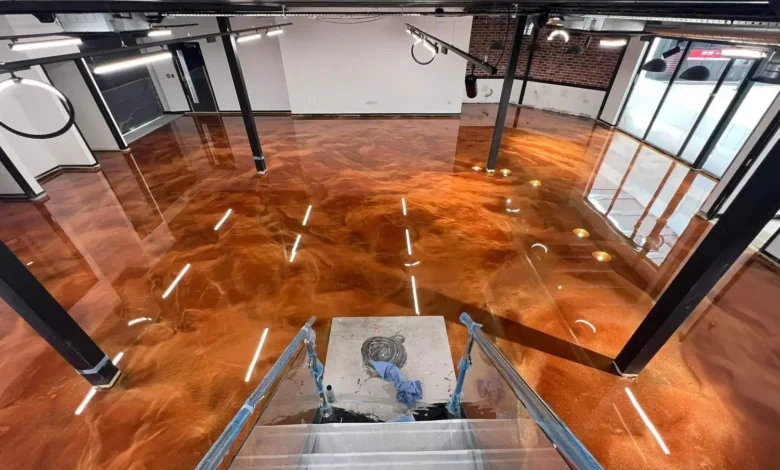
Commercial environments such as showrooms, retail stores, and offices often prioritize appearance alongside practical protection. Metallic epoxy, marble-effect finishes, and decorative flake systems can help create attractive surfaces while supporting routine cleaning.
Garages and parking areas may require coatings that provide resistance to tire marks, oil contamination, abrasion, and moisture. Textured or decorative aggregate finishes can also be considered where additional surface traction is needed.
For outdoor applications, UV exposure, temperature changes, and water resistance become important selection factors. A compatible polyurethane or polyaspartic topcoat may be appropriate, depending on the complete system design.
The Importance of Concrete Preparation
Even high-quality coating materials can perform poorly when applied to an unsuitable surface. Before installation, contractors should inspect the concrete for cracks, dust, oil contamination, moisture, and weak or deteriorated areas.
Mechanical preparation, such as grinding, may be necessary to remove contaminants and create a suitable surface profile. Cracks and joints should be assessed and repaired using compatible materials where required.
Moisture testing is also important because excessive moisture beneath a coating can contribute to blistering, adhesion failure, or delamination. Any moisture-control primer should be selected according to its technical requirements and the measured site conditions.
Working with a Suitable Coating Supplier
Reliable suppliers can help contractors and distributors identify materials that match their project requirements. Businesses should review product data sheets, safety information, mixing ratios, curing times, and recommended application conditions before purchasing.
Manufacturers such as JINCHENG offer different floor coating materials, including epoxy, polyurethane, and polyaspartic options, alongside primer, midcoat, and topcoat products. OEM and private-label support may also be relevant for distributors developing their own product ranges.
Conclusion
Selecting the right floor coating system involves more than choosing a color or finish. Material performance, concrete preparation, environmental conditions, and compatibility between coating layers all influence the final result. By evaluating these factors carefully and working with an experienced supplier, contractors and facility owners can develop flooring solutions that meet their practical requirements and support long-term surface protection.